 Retrofootball
  Belgium
  France
  Germany
  Italy
Italy  Portugal
  Spain
Spain  Switzerland
  United Kingdom
  other countries
  Retrorugby

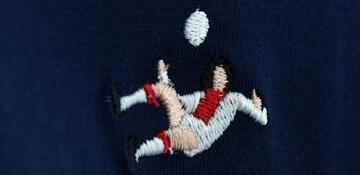
Before we begin this journey through some of the most iconic national teams never to lift the World Cup, it is worth taking a moment to look at the stage on which football’s next great chapter will be written: the 2026 FIFA World Cup. A historic edition of the tournament that promises to mark a new era in the history of the beautiful game.
The World Cup will take place between 11 June and 19 July 2026 and, for the first time ever, will be hosted by three nations: Mexico, the United States and Canada. It will also be the first World Cup to feature 48 teams, bringing an end to the familiar 32-team format that had been in place since France 1998.
The new structure will see the 48 nations divided into 12 groups of four teams. The top two sides from each group, along with the eight best third-placed teams, will progress to a new Round of 32 before the traditional Round of 16, quarter-finals, semi-finals and final. In total, 104 matches will be played, making it the biggest World Cup in history.
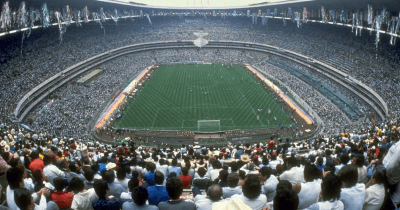
Azteca Stadium - WC Mexico 86
Matches will be staged across 16 host cities throughout North America, from the legendary Estadio Azteca in Mexico City to Vancouver, Toronto, Miami, Dallas, Los Angeles and Seattle. The final itself will be played at the MetLife Stadium in New Jersey, part of the New York metropolitan area, where football’s next world champion will be crowned.
The usual footballing giants are once again among the favourites. Defending champions Argentina will be joined by Brazil, France, Spain, England, Germany and Portugal as leading contenders for the trophy. There is also considerable excitement surrounding nations such as Morocco, Japan and Colombia, while hosts Canada, Mexico and the United States will all be hoping to make their mark on home soil.
However, as every World Cup reminds us, the history of football is not written solely by the champions. It is also shaped by those teams that captivated their nations’ fans, that came within a whisker of glory—perhaps due to a standout match against a stronger opponent—that produced great generations of players, and that wore some of the kits that have since become iconic.
It is to these teams that this article is dedicated: a journey through football history, legendary World Cup moments and the retro shirts that continue to inspire supporters decades later.
Mexico: a familiar face at the World Cup
Few national teams can claim such a long-standing relationship with the World Cup as Mexico. El Tri have appeared in 18 World Cups: 1930, 1950, 1954, 1958, 1962, 1966, 1970, 1978, 1986, 1994, 1998, 2002, 2006, 2010, 2014, 2018, 2022 and 2026.
Mexico also occupies a unique place in World Cup history. Having hosted the tournament in 1970 and 1986, it will become the first nation to stage matches at three different World Cups when the 2026 edition gets underway across North America.
Their best performances came on home soil. In both 1970 and 1986, Mexico reached the quarter-finals, backed by passionate support and playing in a country with a deep-rooted World Cup tradition.
From USA 1994 to Brazil 2014, Mexico achieved a remarkable level of consistency, reaching the knockout stage in seven consecutive World Cups and establishing themselves as one of the tournament's most reliable participants.
Although Mexico have never won the World Cup or reached the semi-finals, they have built a rich World Cup history and worn some of international football's most memorable shirts. The designs of the 1970s and 1980s, associated with their quarter-final runs, remain particularly popular among collectors and retro football supporters in Mexico today.
.
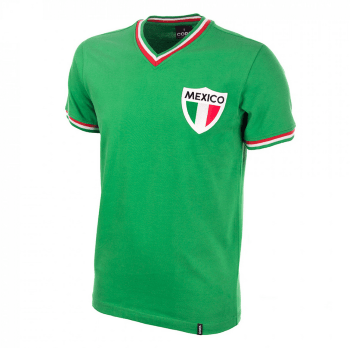
México 1970 shirt
The vintage Mexico 1970 football shirt commemorates and symbolises the first time Mexico hosted the World Cup in 1970. The Mexican national team reached the quarter-finals, a very impressive performance. The squad included El Halcón Peña, as captain, and striker Javier Valdivia.
Browse other retro shirts and jackets from the Mexico national team.
The United States: a World Cup history with more tradition than many realise
Although it is not usually counted among the major powers of world football, the United States has a longer history than many fans realise. It has taken part in the World Cups of 1930, 1934, 1950, 1990, 1994, 1998, 2002, 2006, 2010, 2014, 2022 and 2026 – a total of eleven World Cups.
Its best result came in the first edition of the World Cup, Uruguay 1930, where it reached the semi-finals and finished among the top four teams in the tournament, specifically in third place. Decades later, American football received a major boost by hosting the 1994 World Cup, an event that marked the definitive growth of the sport in the country and where the team finished in the round of 16.
On the sporting front, their most notable performance of the modern era came at Korea and Japan 2002, when they reached the quarter-finals after eliminating Mexico in the round of 16. Since then, the United States has established itself as a regular presence at World Cups, combining young talent with an increasingly professional structure.
As hosts of the 2026 World Cup, the US national team is once again dreaming of achieving the best performance in its history and capitalising on the support of its fans to take a new competitive leap forward.
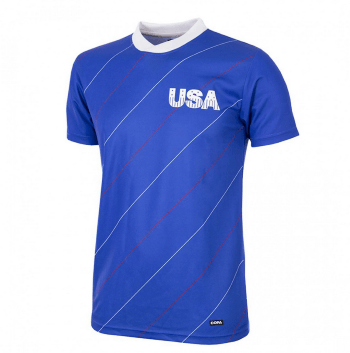
USA 1984 retro soccer shirt
One of the standout players for the US national team during the 1984 Olympic Games was Rick Davis, who captained the side that year. At the time, he was one of the most popular and admired players in the North American Soccer League (NASL), where he had established himself as a true icon of US soccer. The Salvadoran-American player Hugo Pérez, who spent his career in the US, also wore this shirt. We are sure that in the 2026 World Cup, which the US is hosting, it will not go unnoticed.o.
Portugal: a European football power still chasing the World Cup dream
Few national teams have undergone such a spectacular transformation in recent decades as Portugal. The Portuguese side can boast of having won Euro 2016 and the UEFA Nations League in 2019 and 2025, but it still has unfinished business with history: it has never won a World Cup.
For much of the 20th century, Portugal was a sporadic presence at World Cups. In fact, until 2002, it had only reached the finals twice. Its first major appearance came at England 1966, where a legendary generation led by the incomparable Eusébio stunned the whole world. The Portuguese reached the semi-finals and finished in a brilliant third place, their best result to date. Eusébio, who scored nine goals, also became the tournament’s top scorer and remains one of the greatest figures in World Cup history.
It took twenty years for Portugal to return to the World Cup. At Mexico 1986, they returned to the international elite, although their campaign ended at the group stage. This was followed by another sixteen-year absence before the start of a period of consistency that has made the Portuguese national team a regular fixture at the tournament.
Since 2002, Portugal has featured in every World Cup: Korea and Japan 2002, Germany 2006, South Africa 2010, Brazil 2014, Russia 2018, Qatar 2022 and the 2026 World Cup. Their best performance in this new era came at Germany 2006, when a generation led by Luís Figo, Deco, Ricardo Carvalho and a young Cristiano Ronaldo reached the semi-finals and finished in fourth place.
Although the World Cup trophy remains elusive, Portugal has produced some of the most elegant and recognisable kits in the history of international football. Designs that evoke Eusébio, Figo or Cristiano Ronaldo and hold a special place in the memories of retro football fans.
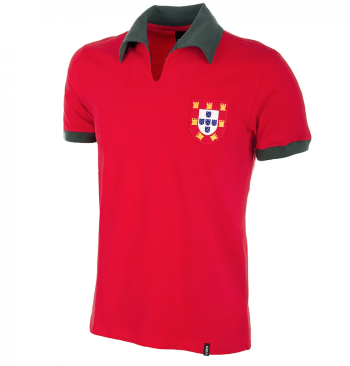
Portugal retro shirt 1972
El The legendary Portuguese player Eusébio wore this retro Portugal football shirt; it is worth noting that he retired from the national team in 1973. This is one of the iconic shirts of the Portugal national team; it was the first time the polo collar was dyed green, thus emulating the colours of the Portuguese flag. Previously, the Portuguese team had worn a round-necked shirt in the same colours, and in 1964 the shirt also had a shirt or polo collar. But this one from the 1970s is considered one of the most elegant in the national team’s history. The Portugal 1972 away shirt in white is of a class rarely seen in football shirts.
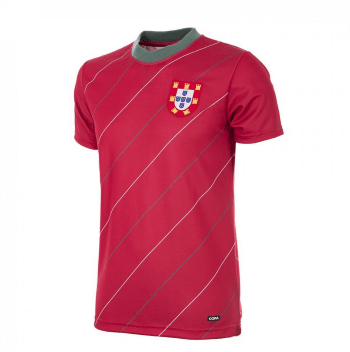
Portugal shirt 1984
There are images of the great Fernando Chalana, the ‘Little Genius’, wearing this shirt from the 1984 Portugal national team, specifically at the 1984 European Championship when Portugal reached the semi-finals. semifinales.
Browse other retro shirts, jackets and socks from the Portugal national football team
Croacia: the team that came close to world glory
Since gaining independence, Croatia has become one of the most competitive teams in European football despite its short history. It has taken part in the World Cups of 1998, 2002, 2006, 2014, 2018 and 2022, and will also be competing in 2026.
Its first major appearance came at France 1998. On its World Cup debut, it surprised the world by finishing third thanks to an unforgettable generation led by Davor Šuker, Zvonimir Boban and Robert Prosinečki. Šuker was also the tournament’s top scorer.
Two decades later came the greatest achievement in their history. At the 2018 World Cup in Russia, with Luka Modrić as their undisputed leader, Croatia reached the final after knocking out Denmark, Russia and England. Only a formidable France side could prevent them from lifting their first World Cup trophy.
Far from being a fluke, the Croatians once again demonstrated their competitiveness at the 2022 World Cup in Qatar. After defeating Brazil in the quarter-finals, they finished in a creditable third place, cementing their status as one of the great teams of the 21st century.
With two third-place finishes and a World Cup runners-up spot, Croatia continues to chase the coveted title. Meanwhile, their distinctive chequered shirt remains one of the most iconic and recognisable in international football.
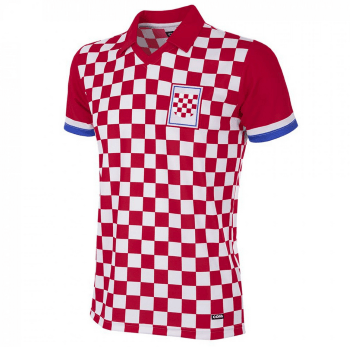
Croacia vintage kit 1992
Croatia gained independence in 1990 and the Croatian national team was readmitted to FIFA in 1992; this shirt celebrates this defining moment, and what better way to do so than with the distinctive red and white chequered design of the crest of this small yet powerful nation in the world of football.
Belgium: the golden generation that fell just short
Belgium has taken part in fourteen World Cups throughout its history, establishing itself as one of Europe’s most competitive national teams. However, despite boasting great players in different eras, it has never managed to win the World Cup.
Back in Mexico 1986, it finished fourth with legendary players such as Enzo Scifo and Jan Ceulemans, and in Brazil 2014 it reached the quarter-finals. Their best performance came at Russia 2018, when the so-called ‘golden generation’, led by Eden Hazard, Kevin De Bruyne and Romelu Lukaku, reached the semi-finals and finished in a brilliant third place after defeating England.
Although a World Cup title remains an unfulfilled ambition, Belgium has produced some memorable teams and some of the most stylish kits in international football, particularly those worn by legendary figures such as Enzo Scifo and the stars of the unforgettable 2018 generation.
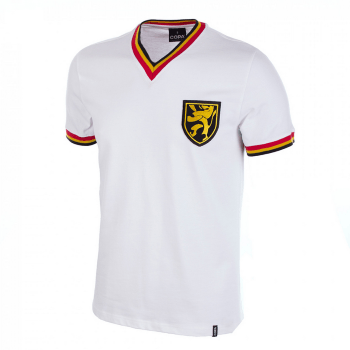
Belgium vintage football shirt away 1972
This shirt, worn by Belgium during the 1972 European Championship, was sported by Belgian football stars such as Van Moer and Van Himst. Indeed, this small European nation has always produced outstanding individual players who have made a real difference.
View the 1960 Belgium shirt in the Red Devils’ signature red
Czech Republic: heir to a great footballing tradition
The Czech Republic has only participated in the 2006 World Cup since gaining independence. However, its World Cup history is closely linked to that of Czechoslovakia, a team that competed in the 1934, 1938, 1954, 1958, 1962, 1970, 1982 and 1990 World Cups, finishing as runners-up in 1934 and 1962.
Although it never lifted the World Cup, Czechoslovakia was one of the most respected teams in European football for decades. At Germany 2006, now as the Czech Republic, it returned to the World Cup driven by a generation of great players such as Pavel Nedvěd, Tomáš Rosický and Jan Koller, although it failed to progress beyond the group stage.
To talk about Czech football is also to talk about Antonín Panenka, born in Prague in 1948, one of the most influential footballers in history. His legendary penalty in the 1976 European Championship final secured victory for Czechoslovakia against West Germany and forever christened one of the most imitated moves in world football: the famous ‘Panenka’, a symbol of talent, personality and composure.
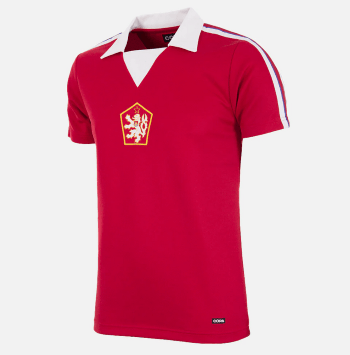
1976 Czechoslovakia Retro Shirt
It’s hard to imagine a more iconic moment in vintage football than Antonin Panenka’s penalty. For this reason alone, this Czechoslovakia retro shirt deserves a place in a display cabinet and a monument, and is highly prized by European football enthusiasts.
Algeria: a team capable of competing on equal terms with top-tier European sides
Algeria has participated in the World Cups of 1982, 1986, 2010 and 2014. Although it has never managed to reach the knockout stages of the tournament, it has produced some memorable moments in the history of African football at the World Cup.
Its debut at Spain 1982 remains etched in the memory thanks to the surprise 2-1 victory over West Germany. However, they were eliminated following the controversial match between Germany and Austria known as the ‘Pact of Gijón’, a result that disadvantaged the Algerians and led FIFA to subsequently introduce simultaneous kick-off times on the final day of the group stage.
Algeria’s best performance came at Brazil 2014, when they qualified for the round of 16 for the first time. There, they pushed the eventual champions, Germany, to the limit, with the Germans needing extra time to secure victory. Since then, the Algerian national team has remained one of the leading lights of African football and a regular contender to spring a surprise in major international competitions; in fact, they have won the Africa Cup of Nations twice in 1990 and 2019.
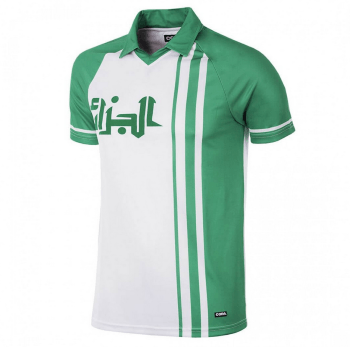
Algeria 1982 World Cup retro shirt.1982.
This shirt is the legendary kit worn by the Algerian national team at the 1982 World Cup in Spain. The player Rabah Madjer was the linchpin of that generation, which finished level on points with Germany and Austria in the group stage.
***
With the 2026 World Cup just around the corner, millions of fans will once again dream of seeing their national team make history and win the World Cup for the first time. Portugal, Croatia, Mexico, the USA, Belgium, the Czech Republic and Algeria are just a few examples of teams which, despite never having lifted the trophy, have left us with unforgettable moments and generations of footballers who are part of football’s collective memory. Their retro shirts are much more than just a kit: they represent an era, evoke great players and keep alive the memory of feats that continue to thrill us decades later. Because if there is one thing capable of telling the story of football from generation to generation, it is precisely those shirts that turn every World Cup into a journey of camaraderie amongst the fans.


Post Comments