 Retrofootball
  Belgium
  France
  Germany
  Italy
Italy  Portugal
  Spain
Spain  Switzerland
  United Kingdom
  other countries
  Retrorugby
Today, we dedicate this article to the 1991-92 season of FC Barcelona, one of the most successful campaigns in the Club’s history.
It was the finest year of Johan Cruyff’s Dream Team, of a league title decided on an unforgettable final day, and of the first European Cup - the previous Champions League - in the club’s history.
That season was also the year in which the city of Barcelona was preparing for the Olympic Games that would transform the city.
Barcelona looks to the future
In 1992, Barcelona was experiencing an extraordinary moment.
The city had been chosen to host the Olympic Games in 1986 and, over the following years, underwent a profound urban transformation. Barcelona was preparing to welcome the world.
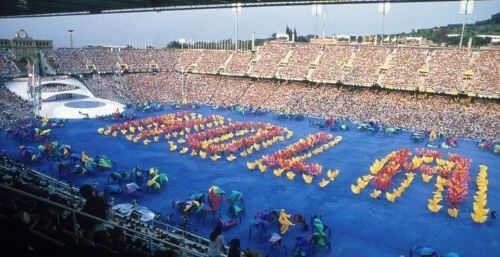
Opening Ceremony of the Barcelona 92 Olympics
And at Barça's football club they were also building something special. Since Johan Cruyff took over as manager in 1988, the club had begun its own sporting transformation alongside the city. The Dutch manager opted for a style of football based on possession, movement and making the ball the main protagonist.
In fact, the trophies began to arrive soon afterwards: the European Cup Winners’ Cup in 1989, the Copa del Rey in 1990 and La Liga in 1991.
But one major trophy was still missing: the European Cup.
Cruyff's Dream Team
The 1991-92 squad brought together an exceptional combination of experience, international talent and players developed through the club’s own youth system.
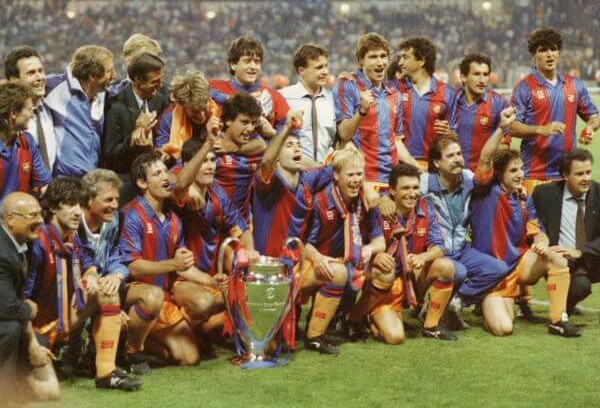
Cruyff’s FC Barcelona Dream Team, European Cup 1992
Andoni Zubizarreta was in goal.
In defence, Ronald Koeman was a key figure, both for his ability to play the ball out from the back and for his extraordinary striking ability, alongside players such as José Ramón Alexanko and Miguel Ángel Nadal.
In midfield was a young Pep Guardiola, alongside players such as José Mari Bakero, Eusebio Sacristán and Guillermo Amor, all important figures in Johan Cruyff’s midfield.
In the more attacking positions were Michael Laudrup, Hristo Stoichkov, Julio Salinas, Txiki Begiristain and Jon Andoni Goikoetxea, key figures in the Dream Team’s attack.
These players, together with the rest of the squad, formed a side that would eventually become known as the Dream Team.
A League title decided in Tenerife
Johan Cruyff’s side had already won La Liga in 1990-91, the previous season. In 1991-92, they had to defend the title while also trying to conquer Europe.
La Liga was a closely fought race involving the two Madrid sides: Real Madrid and Atlético. Barcelona eventually finished with 55 points, Real Madrid with 54 and Atlético Madrid with 53.
The final day was a nerve-shredding affair. Real Madrid went into the final matchday with a one-point lead over FC Barcelona. Barça needed to beat Athletic Club and hope the leaders slipped up.
The final round of matches was played on 7 June 1992. At Camp Nou, Barcelona did their job and defeated Athletic 2-0. But the result of Real Madrid’s match was still to be decided, with the capital club playing in Tenerife.
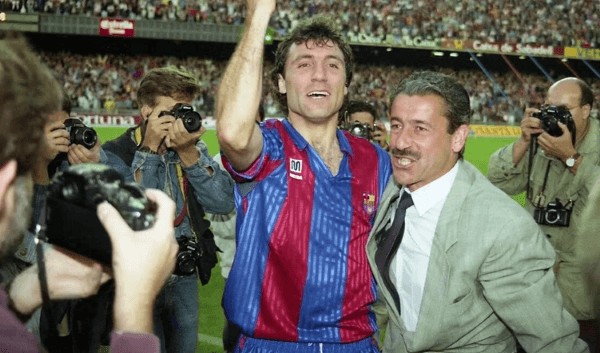
Stoichkov FC Barcleona after winning the 1991-92 La Liga title
Real Madrid side took the lead, but Tenerife eventually came back to win 3-2. The result meant that Barcelona overtook Madrid in the table and were crowned champions. That final day would forever be associated with the Dream Team.
It was their second consecutive La Liga title and the continuation of a run of four consecutive championships: 1990-91, 1991-92, 1992-93 and 1993-94.
Stoichkov and Koeman finished as the third- and fourth-highest scorers in the Primera División, with 17 and 16 goals respectively.
The road to Wembley
Winning La Liga again in the 1992 season gave the team a huge confidence boost. But there was still one trophy that Cruyff and the club had been dreaming of for years: the European Cup.
Barcelona began their European campaign against Hansa Rostock, the club from Germany’s Baltic Sea coast. At Camp Nou, Barcelona won 3-0, with two goals from Laudrup and one from Goikoetxea. Although they lost the second leg 1-0, they went through with a 3-1 aggregate victory.
In the next round, Kaiserslautern stood in their way, the club closely associated with German football legend Fritz Walter. Barça won 2-0 at home, but the second leg in Germany became one of the most dramatic moments of the season. Kaiserslautern went 3-0 up and Barcelona were heading out. Until José Mari Bakero appeared. In the closing minutes, he scored the 3-1 goal that sent Barça through on the away-goals rule.
Then came the group stage, with Sparta Prague, Benfica and Dynamo Kyiv.
Barcelona beat Sparta 3-2 at home, drew 0-0 with Benfica in Lisbon and secured two crucial victories against Dynamo: 2-0 in Kyiv and 3-0 at Camp Nou.
A 1-0 defeat in Prague left the qualification wide open, but Barça secured top spot by beating Benfica 2-1 in their final match.
The opponent in the final would be Sampdoria. The setting: Wembley.
The Wembley Final and the First European Cup
On 20 May 1992, Barcelona and Sampdoria faced each other at Wembley. The match was intense and evenly balanced. After 90 minutes, the score remained 0-0. Extra time was required.
And then came the moment that changed the history of the club. Following a free-kick awarded to Barcelona after a foul on Eusebio, the Catalan side worked a rehearsed set-piece. Ronald Koeman stood over the ball, Hristo Stoichkov played a short pass, José Mari Bakero stepped over the ball, and the Dutch defender struck it powerfully. The shot found the back of Gianluca Pagliuca’s net.
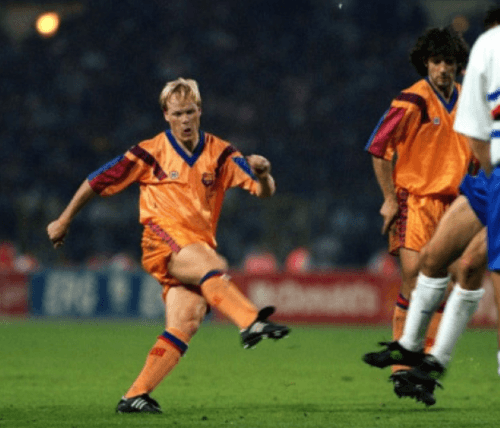
Ronald Koeman’s free-kick – FC Barcelona at Wembley – European Cup 1992*
112th minute
FC Barcelona 1-0 UC Sampdoria.
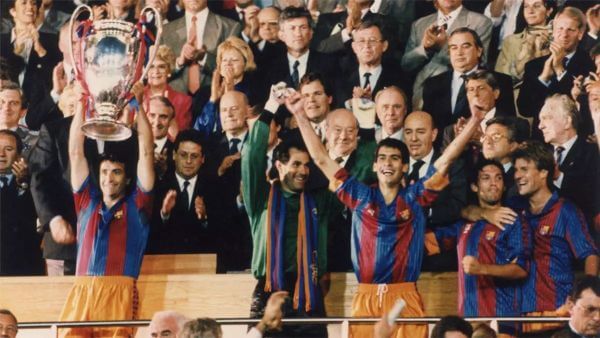
Alexanko, Zubizarreta, Guardiola, Goikoetxea and Laudrup, FC Barcelona players at Wembley with the European Cup 1992
It was the only goal of the final, and FC Barcelona were crowned European champions for the first time.
After the finals lost in 1961, the one in Bern against Benfica, and the traumatic 1986 final against Steaua Bucharest, decided on penalties after a 0-0 draw, when Helmuth Duckadam saved all four Barcelona penalties, the club finally lifted the European Cup. The great European objective of the Cruyff era had been achieved.
A third trophy: the Spanish Super Cup
In 1992, Barcelona also won the Spanish Super Cup, successfully defending the trophy after having won it the previous year in 1991.
Their opponents were Atlético Madrid, the Copa del Rey winners that year. In the first leg, Barcelona beat Atlético 3-1 with a goal from Julio Salinas and a brace from Txiki Begiristain, all three goals coming in the second half. In the second leg, Atlético were beaten once again, this time 2-1, thanks to goals from Begiristain and Stoichkov, successfully retaining the trophy with a final aggregate score of 5-2.
Thus, the official record for the 1991-92 season was three trophies: La Liga, the Spanish Super Cup and the European Cup.
(It is worth making a historical clarification here: Barça also won the European Super Cup, but that trophy belongs to the 1992-93 season. Cruyff’s side defeated Werder Bremen 3-2 on aggregate.)
The Dream Team’s great year
In the end, what made 1991-92 so extraordinary was that the two major trophies were secured in the final moments, with the Barça supporters holding their breath.
The Dream Team would go on to win more league titles and would reach another European final in 1994. But the first European Cup could only be won once.
A retro shirt to remember FC Barcelona 1991-92
The most famous image from Wembley is inevitably linked to Koeman and his free-kick, but also, as always, to the jubilant celebrations that followed, lifting the trophy. It was at that moment that the players wore the 1991-92 Barcelona shirt with its iconic blaugrana stripes, a symbol of the club’s identity.
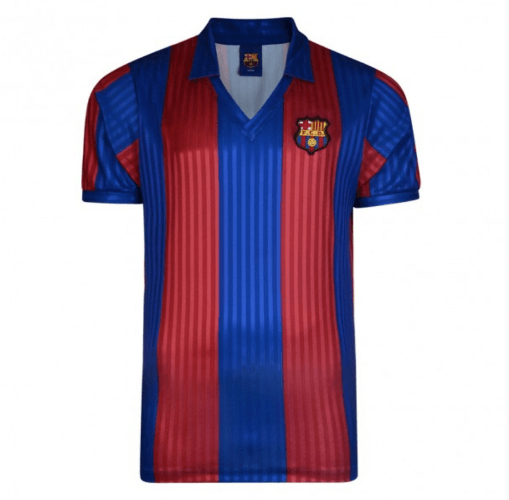
At Retrofootball, we know that classical football shirts have a special appeal for football fans. They are not simply reproductions of an old kit: they bring back the memory of a historic season.
We leave you the link to the FC Barcelona 1991-92 retro shirt , a reminder of the season in which FC Barcelona won the European Cup for the first time, when names such as Cruyff as manager, Koeman, Guardiola, Laudrup, Stoichkov, Bakero and Zubizarreta, together with the rest of their team-mates, formed one of the most recognisable sides in European football.


Post Comments