 Retrofootball
  Belgium
  France
  Germany
  Italy
Italy  Portugal
  Spain
Spain  Switzerland
  United Kingdom
  other countries
  Retrorugby

The Cruyff legend is still alive, and the player continues to inspire new generations. Today we look at four key periods of his footballing life: his childhood and early years at Ajax, his journey at Barcelona, the 1974 World Cup, and the final chapter of his playing career in the Netherlands.
Johan Cruyff's childhood at the foot of the Ajax Stadium
Hendrik Johannes Cruijff was born in 1947, just after the end of the Second World War. His parents, part of the generation that had to rebuild Europe from the ruins, shaped his character. He always understood football and life as a process of constant progress. For him, football was not just about matches and results, but about an idea: before talent or speed, what mattered most was respect for the fundamentals, the environment and the people. This way of thinking was born long before his fame, during his childhood in Betondorp, a working-class neighbourhood of Amsterdam known as the “concrete village”.
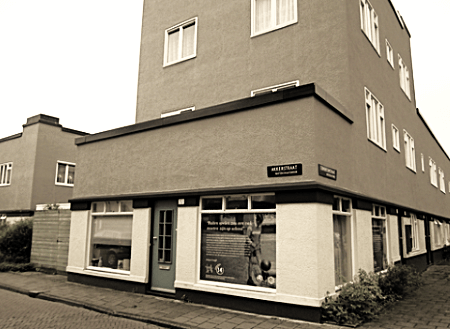
The house where Johan Cruyff was born in Betondorp, Amsterdam
He began his football career at the age of 10 in the Ajax Amsterdam youth teams. His parents owned a greengrocer’s shop in Betondorp, close to the Ajax ground; from the very beginning, his life was pure Ajax. His father attended every match, so young Johan spent his early years immersed in the football atmosphere of a neighbourhood next to the stadium. That builds character, as anyone who has lived near a ground knows. At that time, the street was the world for children, and Cruyff learned to play football on the street, kicking the ball against the kerb so that, by rebounding at strange angles, he learned that the obvious angle is not always the best option. For Cruyff, many of the skills that later amazed the world were born simply from playing non-stop in the street. He later told all of this himself in his memoirs.
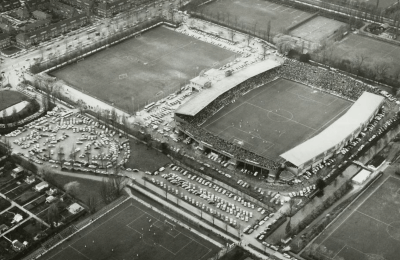
The Ajax stadium, De Meer
When he was five years old, his father introduced him to a friend, Henk Angel, the stadium caretaker and a key figure in his life. Angel took him on as a helper to carry out tasks at the club, and from childhood Cruyff ran through the corridors of De Meer. From then on, the club became his second home. Those experiences, and the conversations he overheard, taught him the importance of order, responsibility and respect for the pitch.
The death of his father when Johan was twelve deeply marked his life. From that point on, Ajax took on an even more central role. The club supported his family and gave work to his mother, Nel, who cleaned dressing rooms and coaches’ houses. Later, his mother married Henk Angel, who became a second father to him, definitively strengthening his bond with Ajax.

Young Cruyff wearing an Ajax jacket
AFC Ajax (1964-1973)
Johan Cruyff’s first spell at Ajax (1964–1973) marked the most decisive period in the club’s history; it was the era in which a little-known club became a dominant force in European football. Cruyff made his first-team debut on 15 November 1964, at just 17 years of age, and in less than a decade he went from being a young prospect to the undisputed leader of a revolutionary side.
The great architect of that transformation was Rinus Michels, Ajax coach from 1965 onwards. Michels introduced a new concept of the game based on collective pressing, intelligent use of space and constant movement, what would later become known as Total Football. The management of space was fundamental: with the ball, the pitch had to be as wide as possible; without it, as compact as possible. His football was intelligent and collective, breaking away from traditional rigid positions. This idea, applied at Ajax, Barcelona and the Dutch national team during the 1970s, laid the foundations of modern football. Cruyff was the perfect interpreter of that idea: a technically exceptional player, tactically brilliant, with total freedom to roam the pitch. He was not a classic striker, but the brain of the team, capable of organising, finishing and pressing.
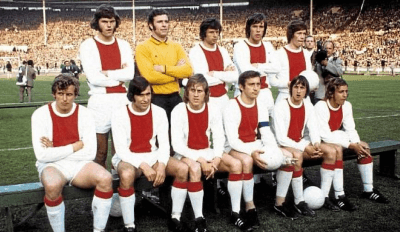
Around Cruyff, an extraordinary generation took shape: Heinz Stuy, Wim Suurbier, Horst Blankenburg, Barry Hulshoff, Ruud Krol, Johan Neeskens, Arnold Mühren, Gerrie Mühren, Johnny Rep, Piet Keizer, among others.
They all shared a common technical education and an advanced understanding of the game, the result of Ajax’s structured work from the academy through to the first team. Michels created the system; Cruyff pushed it to its limits and made it work on the pitch.
The results were historic. During Cruyff’s first spell, Ajax won six Dutch league titles (1966, 1967, 1968, 1970, 1972 and 1973) and four Dutch Cups. But the real leap came in Europe: the club lifted three consecutive European Cups in 1971, 1972 and 1973, a feat reserved only for the greatest teams in history. Cruyff was decisive in all three and captain in the last.
On an individual level, Cruyff won three Ballon d’Or awards during this period (1971, 1973 and, after his departure, 1974), a reflection of his continental dominance. When he left Ajax in 1973 to sign for Barcelona, the club was no longer just a champion: it was a footballing model admired and copied across Europe.
.
FC Barcelona (1973-1978)
Johan Cruyff’s spell at FC Barcelona (1973–1978) was short on trophies, but monumental in terms of historical, sporting and cultural impact. His arrival marked a turning point for a club that had gone more than a decade without winning the league.
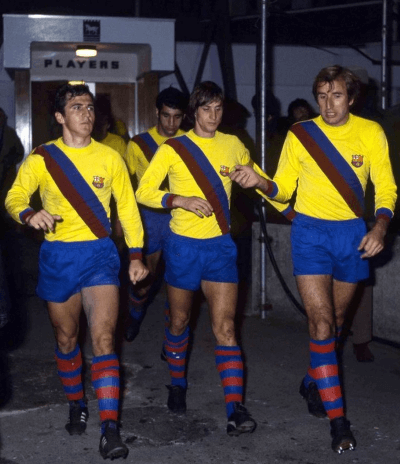
Cruyff with Rexach and Josep Vicenç Tente, FC Barcelona in the 1970s
Cruyff signed for Barcelona in October 1973 from Ajax, in a complex and highly publicised transfer, as the club initially wanted to sell him to Real Madrid but the player refused and chose Barcelona, their great rivals. Rinus Michels, Barça’s head coach, was decisive in bringing Johan Cruyff to the club. From the moment he arrived, the team underwent an immediate transformation. Under Michels’ guidance, Barcelona adopted the principles of Total Football: high pressing, positional play, constant movement and control of the ball. Cruyff did not operate as a traditional striker, but as the organiser of the game from any area of the pitch, raising the level of his team-mates. As the great ones do.
The iconic moment of this era came in the 1973–74 season, when Barcelona won La Liga for the first time since 1960. The triumph was defined by a historic display: the 5–0 victory over Real Madrid at the Santiago Bernabéu in February 1974, with Cruyff as the undisputed leader. That win went beyond sport and carried deep symbolic meaning for Barça supporters in the final years of the Franco regime.

Cruyff scores the second goal for Barcelona against Real Madrid in the 0–5 match of 1974
During his five seasons at the club, Cruyff played 180 official matches and scored 60 goals, figures that do not fully reflect his influence on the game. Collectively, the honours were limited — one league title (1974) and one Copa del Rey (1978) — but his impact far outweighed the trophies won. In 1974, he claimed his third Ballon d’Or as a Barcelona player, cementing his status as the best footballer in the world. His first spell as a player helped Barcelona redefine its identity.
THE NETHERLANDS AT THE 1974 WORLD CUP
The 1974 World Cup, held in West Germany, represents the high point of Johan Cruyff as the footballing leader of the Netherlands national team and the moment when Total Football was consecrated on the world stage. Although the Netherlands did not win the tournament, that World Cup became forever associated with Cruyff and with a way of understanding football that changed the game’s history.
Cruyff arrived at the World Cup as the brain and captain of a Dutch side that had already impressed during qualification with its dynamic, collective and attacking football. What made their style even more striking was the fact that the Netherlands had not played at a World Cup since 1934; this detail helps to understand the true scale of the achievement of that group of players.
Under the guidance of Rinus Michels, the Michels–Cruyff partnership reappeared, and the team transferred to the global stage the principles previously developed at Ajax: high pressing, intelligent use of space, constant movement, and an understanding of the game based on technique and tactical intelligence rather than physical strength. Cruyff was the axis of the system, not as a fixed striker but as a free player who appeared in every area of the pitch. Germany 1974 was the definitive validation of those ideas.
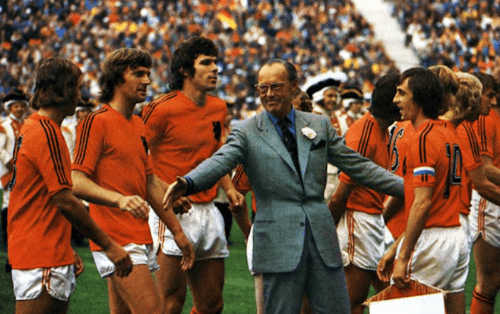
Rinus Michels and the Netherlands team at the 1974 World Cup
From the very first match, the Netherlands, with Johan Cruyff, Rob Rensenbrink, Johnny Rep, Johan Neeskens, Ruud Krol, Wim Suurbier among others, all in inspired form, made it clear they had not come to speculate. In the group stage they faced Uruguay, Sweden and Bulgaria. After beating Uruguay with two goals from Johnny Rep, they drew with Sweden and then produced a crushing display against Bulgaria, winning 0–4.
In the next round they were drawn into the so-called group of death alongside Argentina, East Germany and Brazil. Once again, they overwhelmed an opponent, this time Argentina, with a 4–0 victory in which Cruyff scored twice, opening the scoring. They also defeated Brazil, the reigning world champions, 2–0 in a tense and physical match. Cruyff was the standout figure: after Neeskens’ goal, he scored the second, dismantled the Brazilian defence with his movement, and confirmed his status as the best player of the tournament.
Cruyff not only directed the play, he interpreted it in real time: dropping deep to receive, breaking lines with passes or runs, and leading the press after losing the ball. His goal against Argentina, following a long collective move, symbolised the essence of that team.
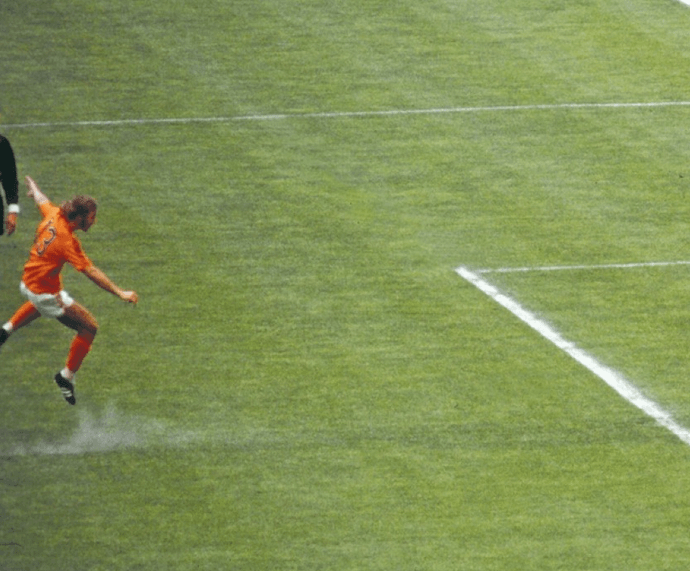
Johan Neeskens converting the penalty in the 1974 World Cup final
The final against West Germany began in symbolic fashion: after a long spell of possession without a German touch, Johan Neeskens converted the opening penalty. Germany reacted before half-time, equalising in the 25th minute through Paul Breitner, and then in the 43rd minute Gerd Müller sealed the 2–1. Despite Dutch dominance, the scoreline did not change.
Cruyff did not lift the trophy, but he won the Ballon d’Or and left an unforgettable legacy. In 1974, the Dutch “Clockwork Orange” were not world champions, but they changed football forever.
THE TWO-STRIPES SHIRT with THE NUMBER 14
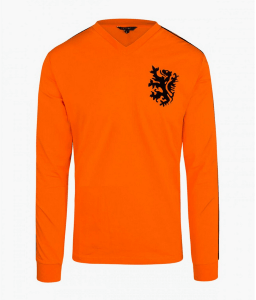
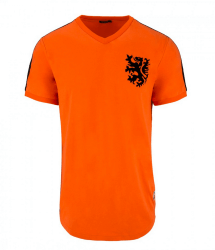
The so-called “brand war” at the 1974 World Cup reflected Johan Cruyff’s independent character. While the Dutch national team was sponsored by Adidas, Cruyff had a personal contract with rival brand Puma. As no agreement was reached between the two parties, the player refused to wear the standard kit. The solution was as simple as it was symbolic: Cruyff played the tournament in a shirt with only two black stripes, instead of the three iconic Adidas stripes worn by his teammates. That seemingly minor gesture reinforced his image as a free-spirited footballer, true to his principles and immune to commercial pressures.
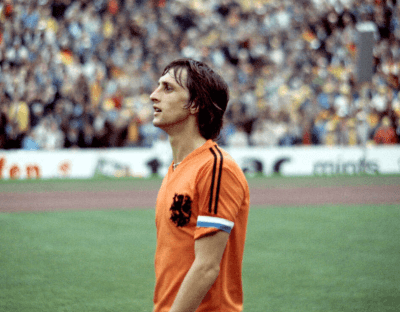
Johan Cruyff at World Cup final 1974
AFC Ajax (1981–83) – Feyenoord (1983–84)
At the end of his career, at the age of 34, Cruyff returned to his roots, to Ajax, the club that had seen him grow. He truly wanted to finish where he had run around as a child, something deeply ingrained in all footballers. But things did not have the happy ending imagined for the prodigal son.
During his first two seasons back (1981–1983), Cruyff helped Ajax add two more Eredivisie titles and a KNVB Cup to their trophy cabinet. However, at the end of that period, club president Tom Harmsen decided not to renew his contract, arguing that he was no longer capable of competing at the highest level. Johan Cruyff himself was shut out of his final year — shut out by the very club he had helped shape, the Ajax of modern football.
In an act of pure rebellion, as had always been the case throughout his life and career, Cruyff responded by signing for Ajax’s great rival, Feyenoord of Rotterdam...
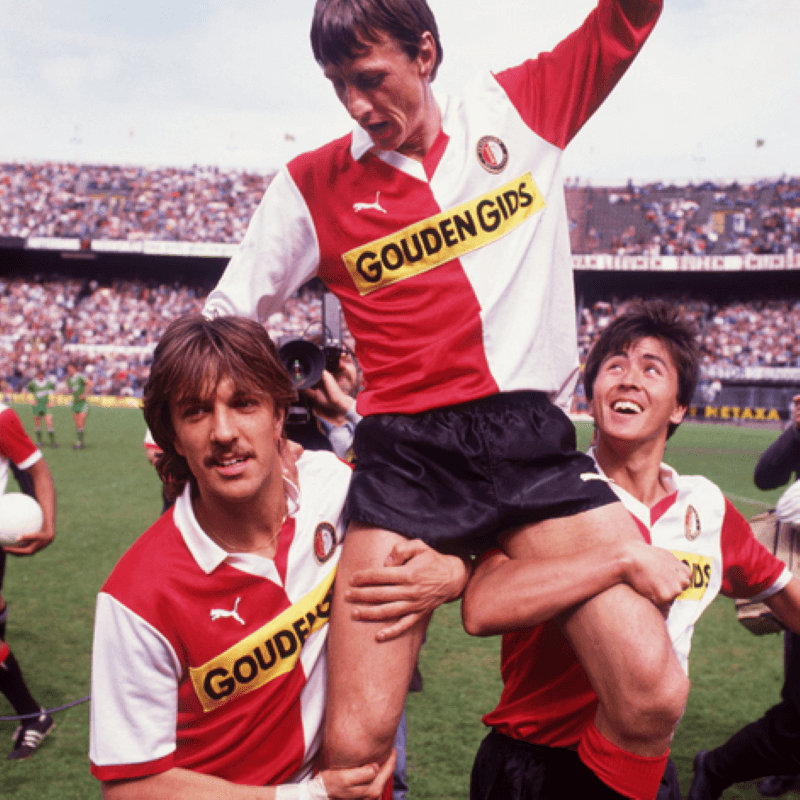
Cruyff at Feyenoord with Ben Wijnstekers and Stanley Brard
He was 37 years old… and he won the league and the cup in the 1983–84 season, as well as being named “Voetballer van het Jaar”, Footballer of the Year in the Netherlands. You only need to watch the footage of his season at Feyenoord to see how he hung up his boots, in a state of pure grace. That is how the greats bow out: making a final statement and leaving as they lived — breaking rules and winning titles.
***
GET YOUR JOHAN CRUYFF SHIRT
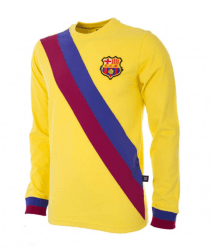
For all Johan Cruyff fans, here you’ll find the stunning retro shirts and jackets he wore at Barcelona and with the Dutch national team. There is no better way to pay tribute to his legend than by wearing his so special jerseys.
RETRO FC BARCELONA 1974–75 SECOND KIT CRUYFF
JOHAN CRUYFF 1974 WORLD CUP - TWO-STRIPES SHIRT - LONG SLEEVE - NUMBER 14
JOHAN CRUYFF 1974 WORLD CUP - TWO-STRIPES SHIRT - NUMBER 14
CRUYFF 1974 WORLD CUP JACKET
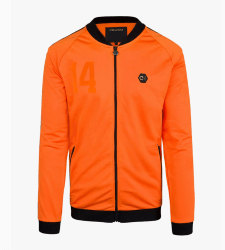
And if you want to dress in casual style, we also leave you the link to the T-shirts from the Cruyff Classics brand — the brand he founded and which continues his unique legacy.
.


Post Comments